6
Comm-SCI-Control Private Runtime
Deterministic governance execution for production wrappers. Commands, contracts, and quality gates stay explicit and auditable.
This private project line focuses on robust wrapper operation for Comm-SCI: strict command routing, SCI state handling, QC and verification enforcement, panel-driven operations, and bilingual project documentation. The core design is LLM-agnostic: the same governance layer can be applied across providers and models with explicit, comparable controls.
Why this wrapper line
From normative JSON to operational reliability
Deterministic command flow
Standalone-only command parsing reduces accidental state changes and keeps automation stable.
Traceable quality enforcement
SCI Trace, Self-Debunking, QC footer, and verification gates are enforced through runtime contracts and make evidence limits explicit.
Operational observability
Comm State, Comm Anchor, Comm Audit, and panel diagnostics expose drift and module status early.
Fit and scope
Who this wrapper is for and what it is not
Good fit
For users who want more efficient human-machine communication, explicit evidence assessment, and reproducible LLM workflows.
Not the objective
Not a cosmetic prompt improver and not a "better prompt trick". The focus is governance, transparency, and controlled quality behavior.
LLM-agnostic uniqueness
The same rule and scoring logic persists across provider switches, enabling fair model comparison and stable regression baselines.
Control-first guidance
Dedicated pages for motivation, scenarios, and limits
The landing page keeps architecture and installation visible. Additional pages provide didactic entry points for why the wrapper exists, when runtime is worth it, and where hard limits remain.
Use cases
Where the wrapper can be applied
School and higher education
Structured argumentation, didactic outputs, and explicit uncertainty handling for learning workflows.
Science and research
Comparable prompt runs, explicit evidence labeling, auditability, and version-aware documentation.
Regulated professions
Useful for doctors, legal professionals, and other high-accountability roles as a structuring/checking aid, not as a responsibility replacement.
Critical reasoning workflows
Self-Debunking and verification gates support active challenge of plausible but weak claims.
Execution model
Wrapper pipeline in fixed order
-
P0 Parse
Input is classified as standalone command, SCI selection, or content request.
-
P1 Route
Command intent dispatch or governed content route is selected deterministically.
-
P2 State
Runtime state updates are applied (profile, SCI, overlay, language policy, QC overrides).
-
P2B Preflight
Contract guards and compliance prerequisites are checked before content rendering.
-
P3-P4 Contract + Repair
Violations trigger deterministic correction logic or explicit control-layer blocking.
-
P5 Render + Audit
Structured HTML output, timestamps, and audit records are emitted for reproducibility.
Operational modules
Four governance protection surfaces
Control Layer
Maintains strict command contracts, output ordering, and deterministic fallback behavior.
QC and Overrides
Normalizes QC footer targets and keeps explicit override visibility in state and output.
SCI orchestration
Handles pending selection, trace-step requirements, and recurse behavior.
CGI feedback loop
Captures structured user feedback for iterative quality adaptation without hidden state jumps.
Didactic terminology
Dedicated page for all core terms
Orientation
Website tree for quick navigation
Core pages
Install and operations
Terminology and structure
Installation on the website
Main-page quick path plus separate detail pages for beginners and professionals
Quick path on landing page
Core setup remains visible on the homepage so first-time users can start without navigation friction.
Beginner detail page
Includes link, download, unpack, prerequisites, installation, startup, API-key dialog (plaintext/encrypted), passphrase guidance, confidentiality, and cost notes.
Professional detail page
Includes reproducible setup, test/diagnostics paths, provider validation, and explicit policy for encrypted vs plaintext API-key operation.
| On-page quickstart | Command |
|---|---|
| Setup | bash scripts/setup_venv.sh |
| Activate venv | source .venc/bin/activate |
| Start runtime | python Comm-SCI-Control-App.py |
Interface impressions
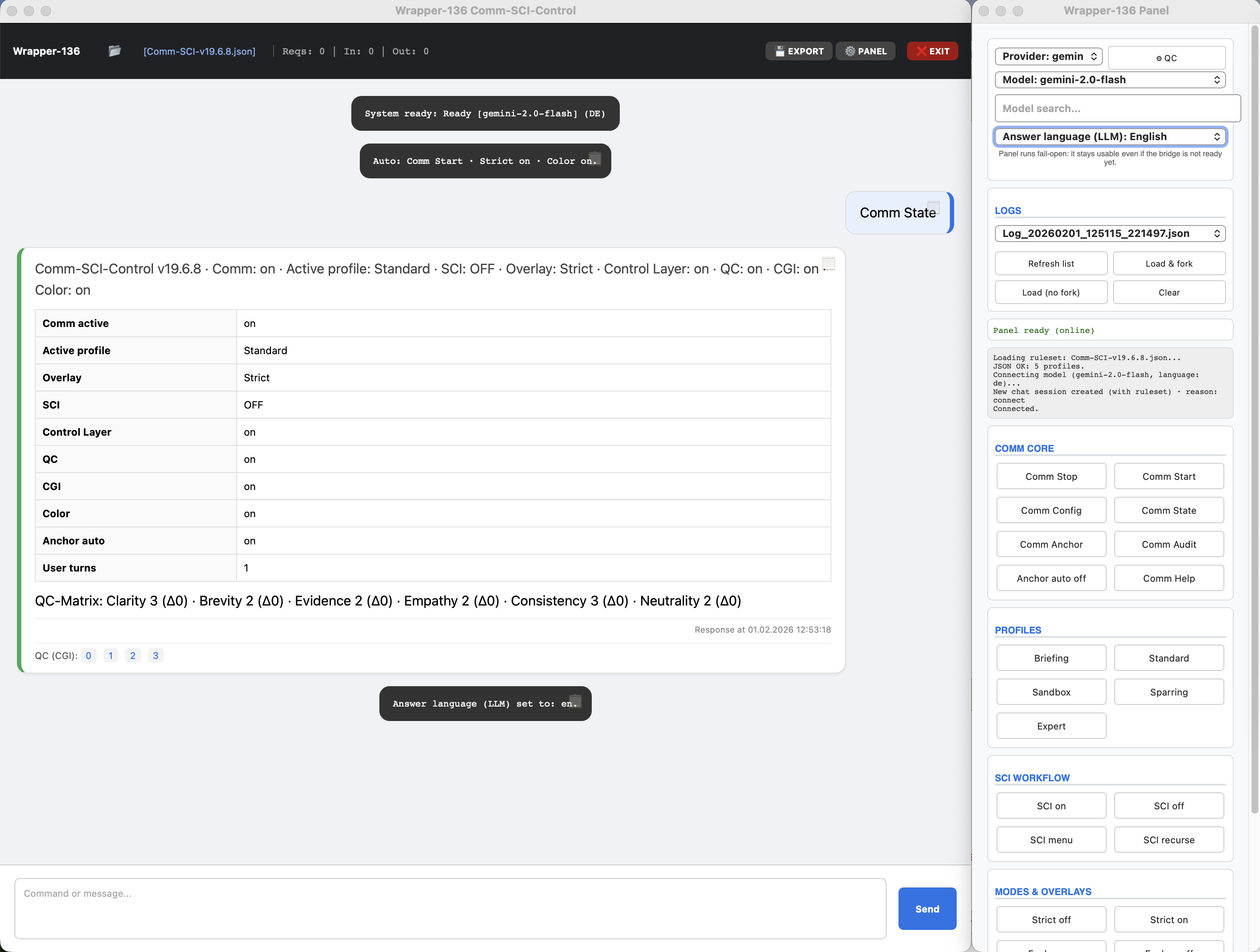
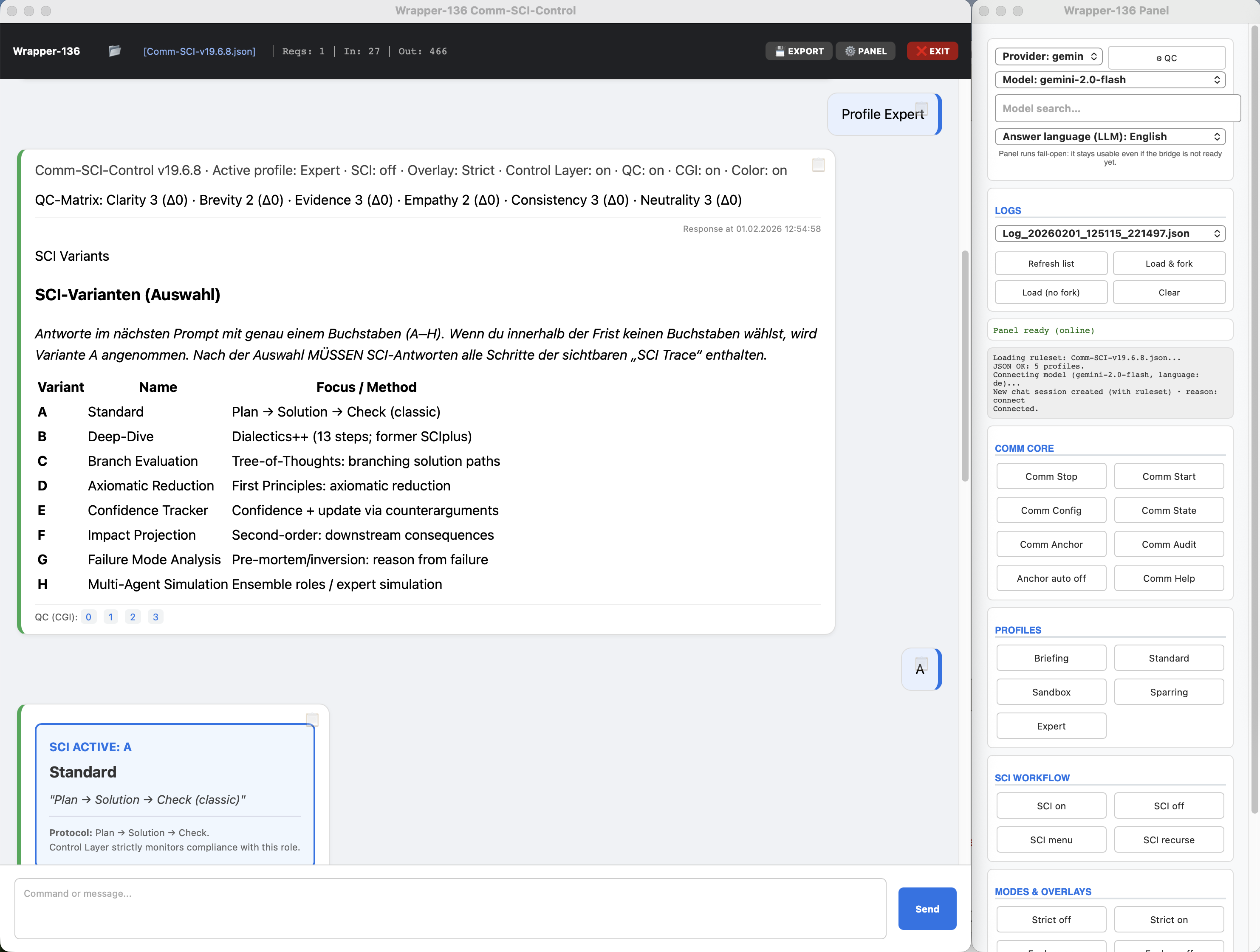
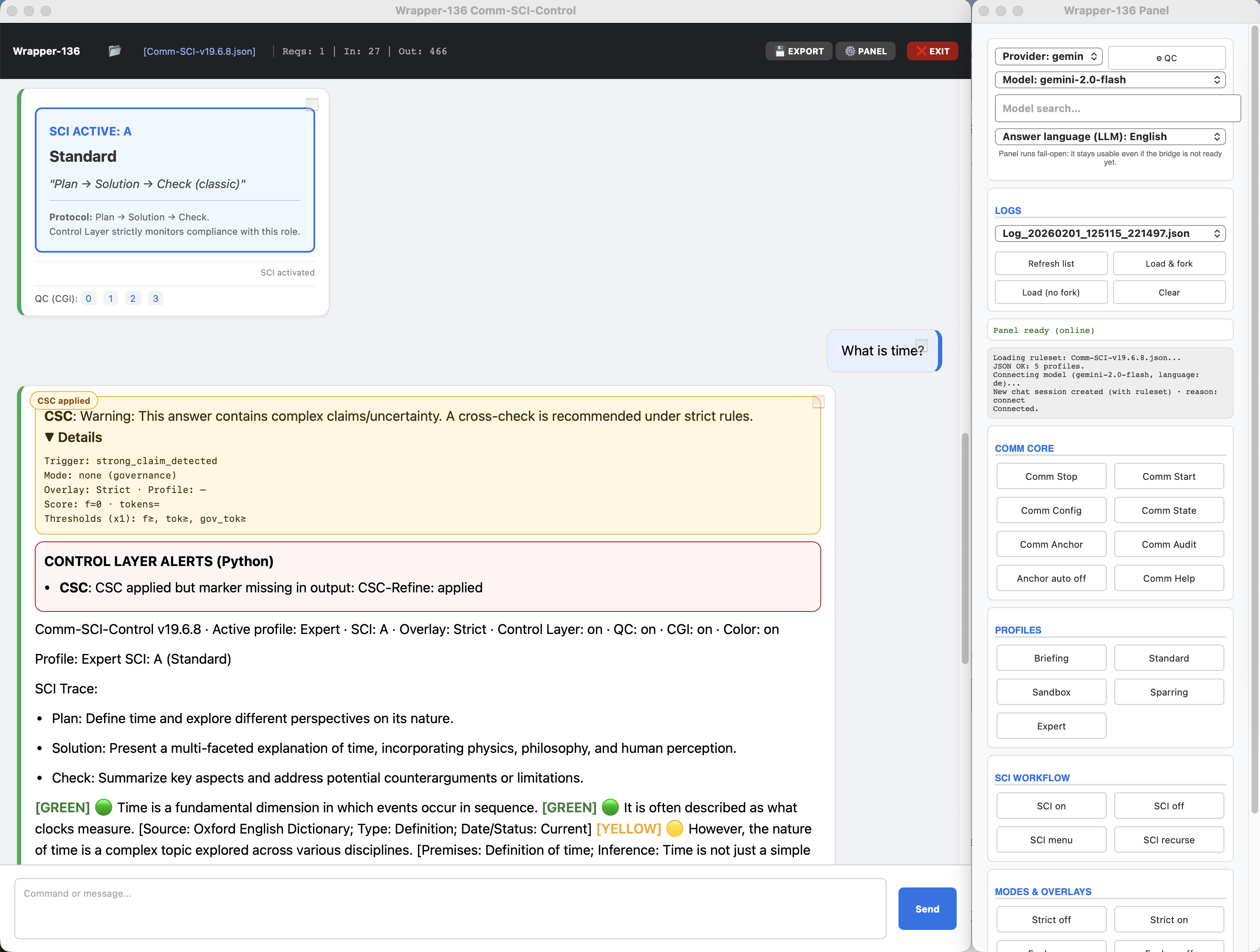
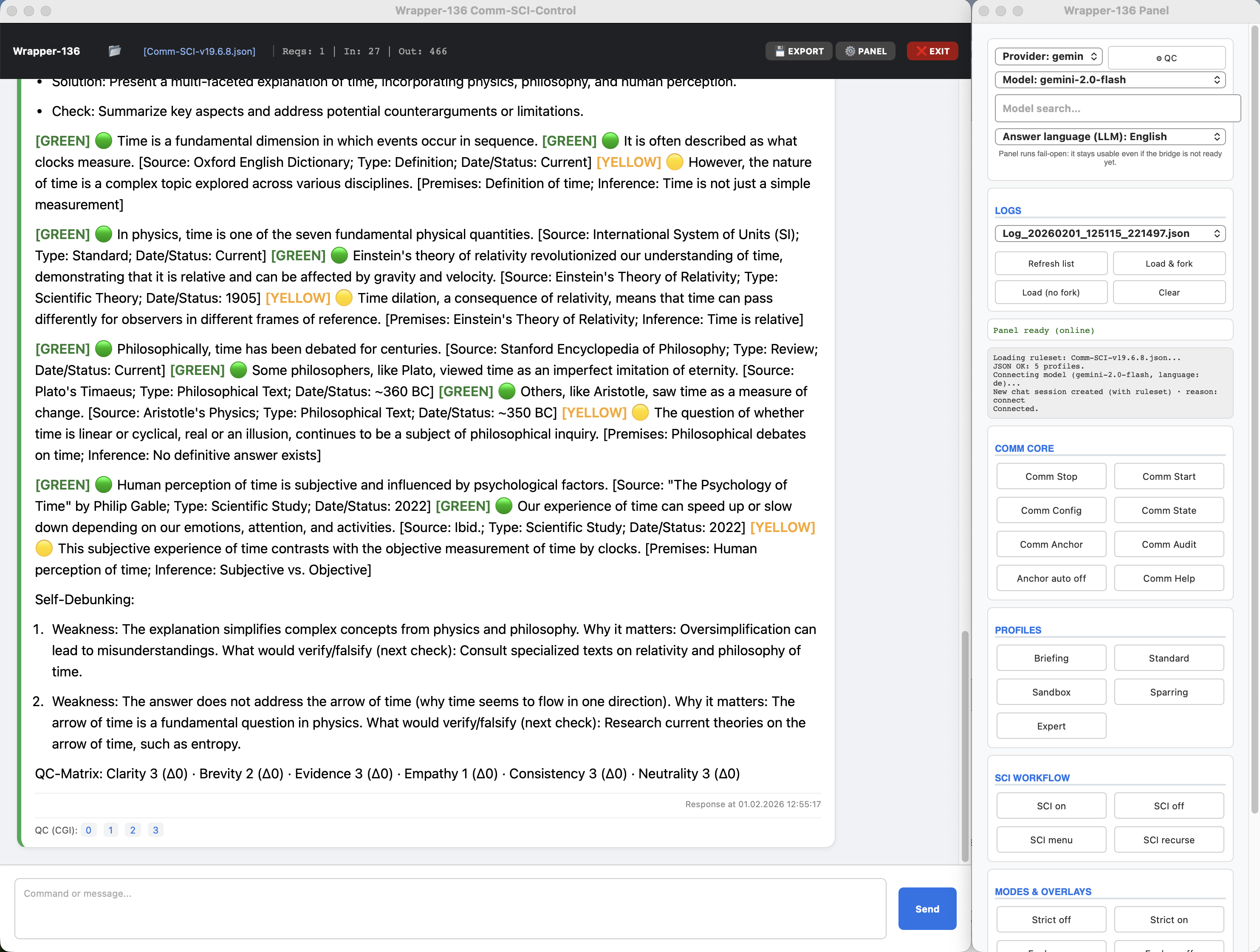
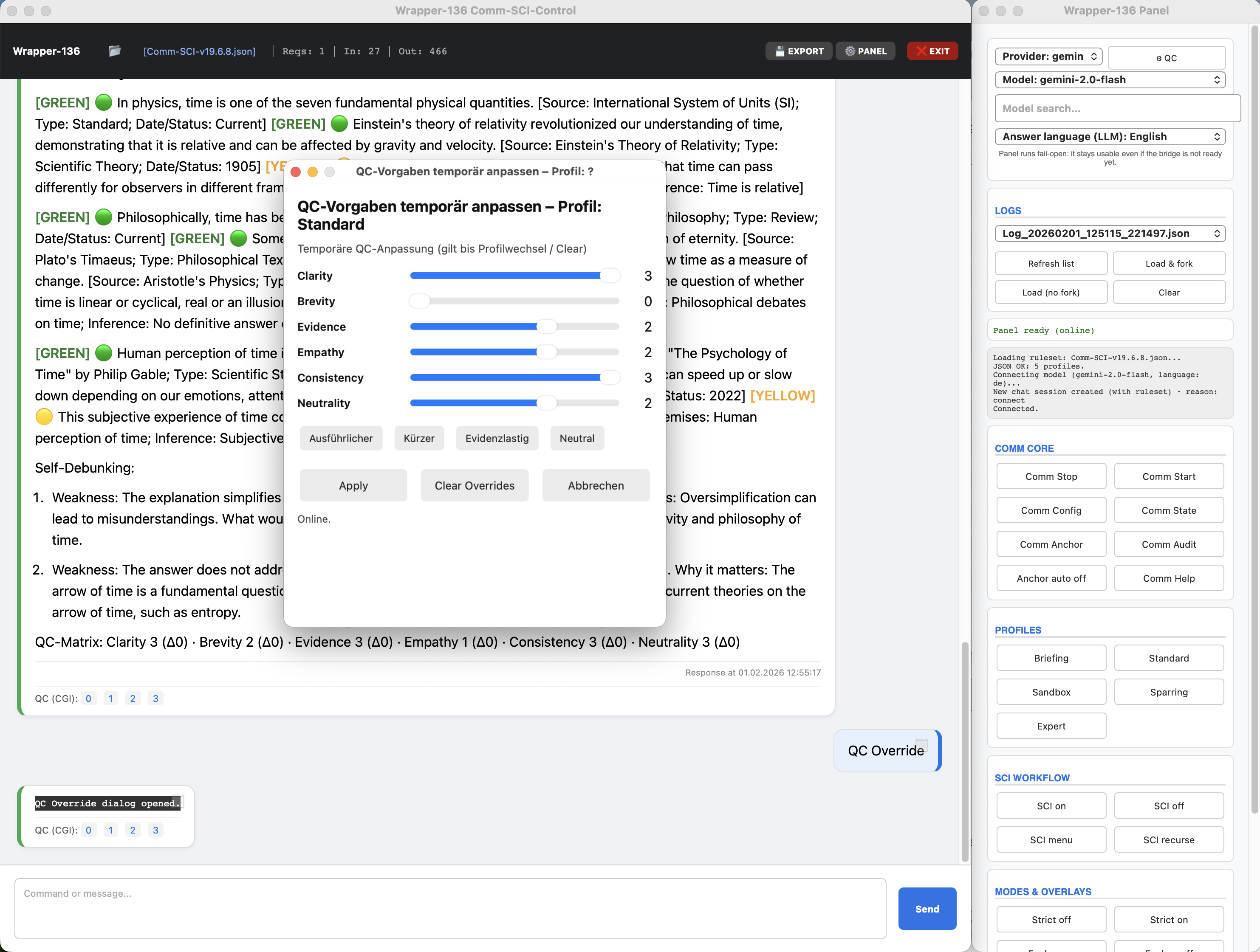
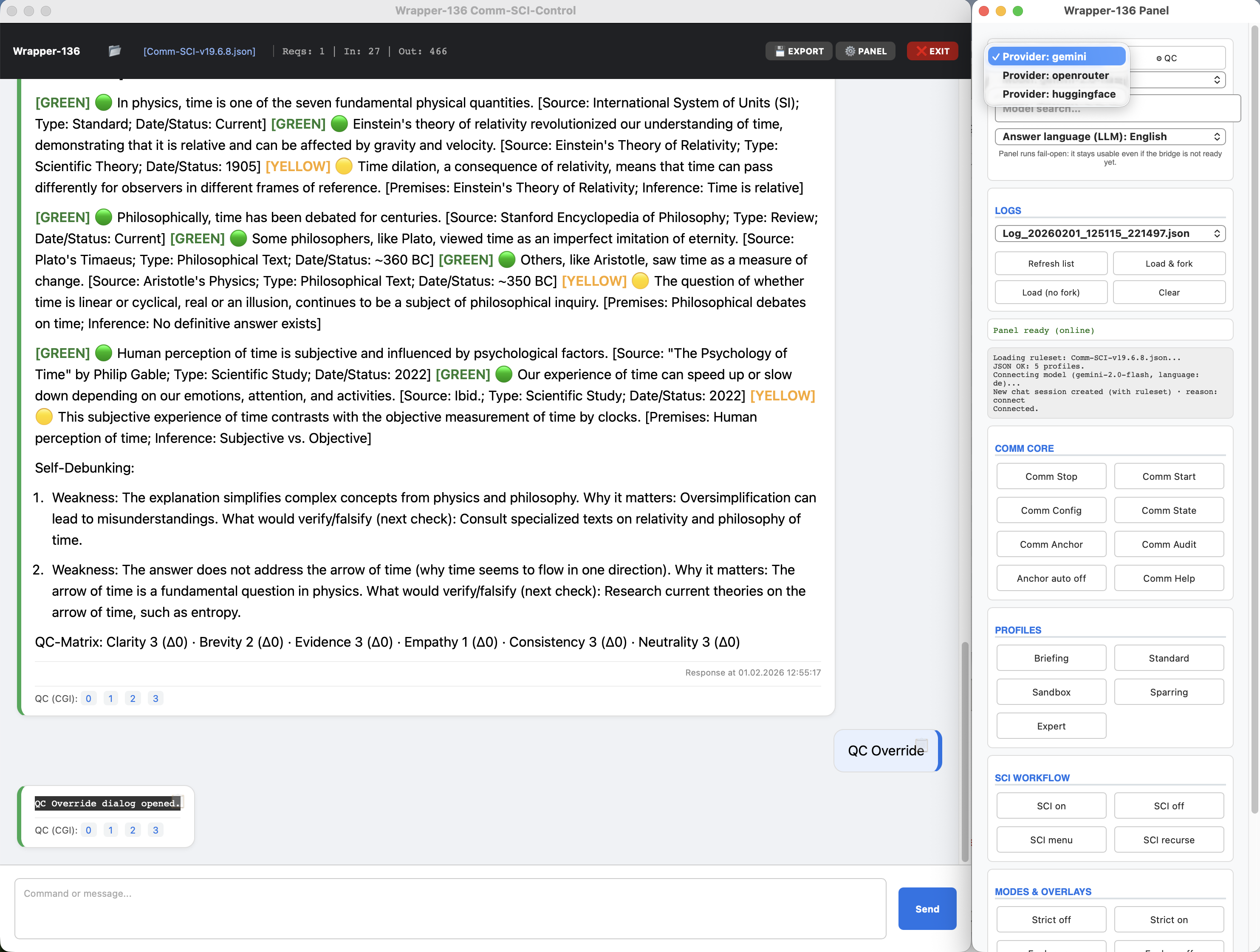
Panel and wrapper UI snapshots
Project documentation
Bilingual docs for operations and architecture
Handbook (EN)
Operational model, command discipline, language policy, and governance playbook.
Handbuch (DE)
Deutschsprachige Betriebs- und Architekturreferenz fuer Team und Review.
README
Quickstart, test commands, repository map, and DOI strategy.
README (DE)
Deutschsprachiger Einstieg fuer Setup, Tests und Betrieb.
Proposal backlog
How extension ideas are documented professionally before implementation.
Install + sync runbook
Production-oriented setup routine and safe local transfer to the wrapper clone.
Beginner install page
Didactic onboarding for non-technical users.
Professional install page
Advanced setup and diagnostics workflow.
Terminology glossary
Didactic explanation of wrapper concepts and governance vocabulary.
Why Wrapper
Purpose, design rationale, and control-first positioning.
Runtime scenarios
When JSON-only is enough and when runtime execution is preferable.
Wrapper limits
Operational trade-offs and explicit non-guarantees.
Manual test checklist
Release-facing manual checks and panel regression routine.
Citation baseline
DOI mapping for wrapper and ruleset
| Resource | DOI / Link | Usage |
|---|---|---|
| Wrapper concept DOI | 10.5281/zenodo.18445672 | Stable reference across all wrapper versions. |
| Ruleset concept DOI | 10.5281/zenodo.17928357 | Normative governance source across releases. |